Why Your Engine Cranks But Won’t Start: Common Causes and DIY Solutions
Many car owners have been there—your engine cranks, but it simply won’t start. It’s frustrating and can leave you feeling stuck. If you’re dealing with this common issue, you’re not alone, and there are straightforward reasons behind it.
If your engine cranks but won’t start, it’s often due to issues with the fuel system, spark, or electrical connections. First, check your battery and verify it’s charged and terminals are clean. Then, inspect spark plugs and fuel delivery, including the fuel pump and filter.
Faulty sensors or immobilizer systems can also cause starting problems. If you keep exploring, you’ll find detailed steps to diagnose and fix these common causes.
Key Takeaways
- Check the fuel system, including the fuel pump and filter, to make sure fuel is properly reaching the engine.
- Inspect the spark plugs and ignition system components for any signs of wear or faults that could stop the engine from igniting.
- Verify the battery voltage and make sure all electrical connections are secure for enough power to start the engine.
- Test sensor signals like crankshaft or camshaft sensors, as these are key for proper engine timing.
- Confirm that the immobilizer or transponder system isn’t preventing the engine from starting.
Why Is My Car Cranking But Not Starting?
Have you ever turned the key and heard your engine crank, but it just refuses to start? This common issue often points to a fuel or ignition problem.
Before jumping to conclusions, check the basics first. Low engine oil levels can prevent your engine from starting, even if you hear the crank. Regularly inspecting your oil keeps the engine running smoothly and helps avoid damage.
Also, don’t forget about tire pressure. While it doesn’t directly affect starting, underinflated tires can cause uneven weight distribution. That can impact your car’s overall health and might indicate other hidden issues.
If your engine cranks but still doesn’t ignite, take a look at your fuel delivery system, spark plugs, and ignition system. These are essential for getting the engine to start.
Keeping your engine oil topped off and your tire pressure at the recommended levels creates a solid foundation for a reliable start. Checking these simple things can often fix many of the common causes of a car that cranks but won’t start.
How Do I Check the Battery and Electrical System?
First off, take a look at your battery terminals. You’ll want to see if there’s any corrosion or if the connections are loose. That can cause all sorts of electrical issues.
Next, grab a multimeter and check the battery voltage. You’re looking for a proper charge, so if it’s too low, that might be your problem. And don’t forget to peek at your fuses and cables—see if there’s any damage or wear that could be messing with your system.
Inspect Battery Terminals
Before diagnosing other electrical issues, inspecting the battery terminals is essential. Loose or corroded connections can stop your engine from starting. Check for signs of battery corrosion—white, powdery deposits on the terminals.
Make sure the terminals are tight and secure. If you see corrosion, clean the terminals with a mixture of baking soda and water. Then, tighten the connections firmly. A clean, tight connection ensures proper power flow.
Test Battery Voltage
Want to know if your battery is providing enough power to start your engine? Start by testing the battery voltage with a multimeter. This simple step is key for good battery maintenance and accurate electrical troubleshooting.
Turn off your vehicle, then connect the multimeter’s red lead to the positive terminal and the black to the negative terminal. A healthy, fully charged battery should read around 12.6 volts.
If you see a reading below 12.4 volts, your battery might be undercharged or failing to hold a charge. Low voltage means you might need to charge or replace it.
Regularly checking your battery voltage helps prevent future problems and makes sure your electrical system stays in good shape. This can save you headaches and costly repairs later on.
Check Fuses and Cables
How can you tell if faulty fuses or damaged cables are stopping your engine from starting? Start by inspecting the fuse box for blown fuses or ones that look burnt or discolored. Replacing these fuses can often restore power to essential components.
Next, check the cable connections. Look for loose, corroded, or frayed cables, especially around the battery terminals and starter. Tighten any loose connections and clean corrosion with a wire brush or terminal cleaner.
Damaged cables should be replaced quickly to ensure proper electrical flow. Having secure cable connections and working fuses is key to delivering the right current to start your engine.
Fixing these issues often solves starting problems caused by electrical faults.
Is Your Spark Plug Firing Properly?
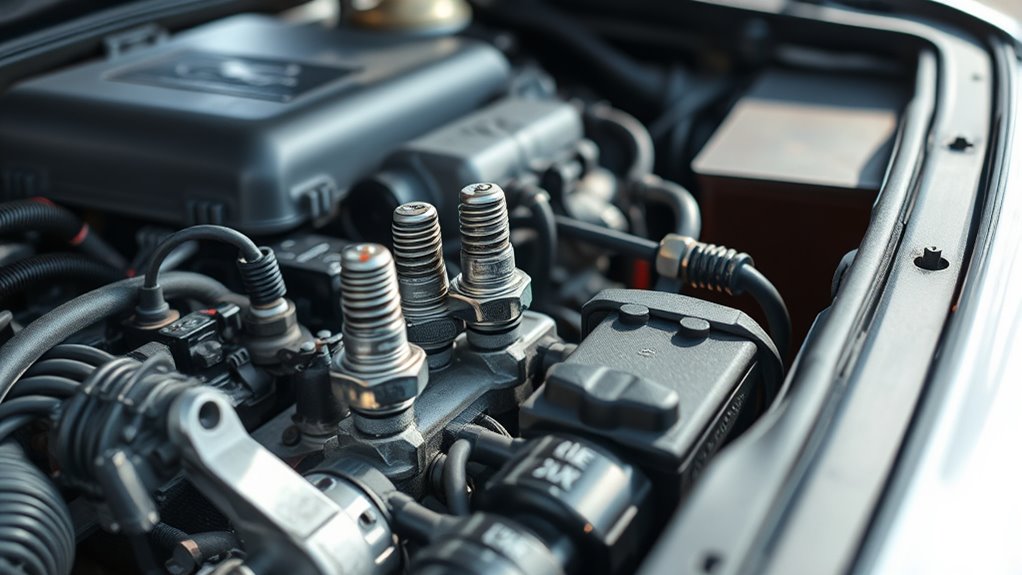
A spark plug that isn’t firing properly is a common culprit when your engine cranks but won’t start. To check this, start with spark plug troubleshooting by removing the plug and inspecting for signs of wear, corrosion, or carbon buildup.
If it looks fouled or worn out, replacing it might solve the issue. You can also test for spark by reconnecting the ignition coil and seeing if a strong, blue spark occurs when cranking the engine.
Ignition coil testing is vital because a faulty coil won’t generate enough voltage to create a spark. Use a spark tester or multimeter to verify proper coil operation.
If the spark is weak or absent, the coil may need replacement. Ensuring your spark plug fires properly is essential for engine start-up.
Regular checks and timely replacements save you hassle and keep your engine running smoothly. Remember, troubleshooting the spark plug and testing the ignition coil are key to diagnosing spark-related ignition problems.
How to Diagnose If Fuel Delivery Is the Problem
If you’re trying to figure out whether fuel delivery is the problem, the first thing to do is see if your fuel pump is running properly. You can usually hear it when you turn the key, but if you’re not sure, there are tests you can do to confirm it’s working.
Next up, take a look at your fuel filter. Sometimes it gets clogged with dirt or debris, and that can block the flow of fuel. If it’s really dirty or clogged, replacing it might solve the issue.
Finally, you’ll want to test the fuel pressure with a gauge. This will tell you if your fuel system is delivering the right amount of fuel to the engine. If the pressure’s too low, then you know there’s probably a problem somewhere in the fuel delivery process. All these steps together will give you a good idea if your engine isn’t getting the fuel it needs to start up.
Check Fuel Pump Function
Ever wonder if your fuel pump is the culprit when your engine cranks but refuses to start? To check, listen for a humming sound near the fuel tank when turning the key to “on.” No sound could mean a faulty fuel pump or electrical issue.
Performing basic fuel pump maintenance, like inspecting wiring connections, can help guarantee proper fuel delivery. A weak or failing pump can cause poor fuel efficiency and hard starting.
You can also check the fuel pressure with a gauge. If it’s lower than the manufacturer’s spec, the pump might be failing. Remember, a healthy fuel pump is crucial for consistent engine start and ideal fuel delivery, preventing costly repairs.
Ensuring your fuel pump is working properly helps your vehicle run smoothly and can save you money in the long run.
Inspect Fuel Filter
Wondering if a clogged fuel filter is preventing your engine from starting? Start by locating the fuel filter, which is usually along the fuel line or inside the fuel tank. Remove or inspect it for signs of dirt, rust, or debris, which can restrict fuel flow.
If the filter looks dirty or clogged, replacing it might solve the issue. Follow your vehicle’s specific replacement guidelines—usually, you’ll disconnect the fuel lines, remove the old filter, and install a new one.
Always make sure the fuel system is depressurized before working on it. A clogged fuel filter hampers proper fuel delivery, preventing your engine from starting or running smoothly.
Regular replacement, typically every 20,000 to 40,000 miles, helps keep your fuel system clean and functioning properly.
Test Fuel Pressure
Testing fuel pressure is an important step when diagnosing a no-start issue. You’ll need a fuel pressure gauge to connect to the Schrader valve on your fuel rail.
Turn the ignition to the “On” position without starting the engine, and watch the pressure gauge. If the pressure is too low or there’s no reading at all, it could mean there’s a fuel delivery problem.
This could be caused by a clogged fuel filter or a failing fuel pump. Keep in mind, even if fuel is reaching the engine, poor fuel quality can affect ignition timing and combustion.
Getting the right fuel pressure helps you rule out fuel delivery as the cause. If the pressure is good but the engine still won’t start, focus on ignition timing and spark issues instead.
Testing the Fuel Pump and Fuel Filter
Before diving into other potential issues, it’s important to check if your fuel pump is delivering fuel properly. Listen for a humming sound from the fuel tank when you turn the ignition to the “on” position—that’s a good sign the pump is activating.
If you don’t hear anything, the pump could be faulty or clogged. You can also test fuel flow by disconnecting the fuel line and briefly turning the ignition on; you should see fuel flowing out.
Make sure your fuel filter isn’t clogged because a dirty filter can restrict flow and make starting difficult. Using fuel additives can help clean out minor deposits blocking fuel delivery.
Keep in mind that ignition timing can also cause starting issues. If the pump and filter seem fine, adjusting the ignition timing might be necessary.
Ensuring proper fuel flow is essential to start your engine smoothly.
Are Your Sensors Affecting the Starting Process?
Could faulty sensors be causing your engine to crank but not start? Yes, sensor malfunction can disrupt the engine’s starting process.
Sensors like the crankshaft position sensor and camshaft position sensor tell the ECU when to ignite the fuel and spark. If these sensors send incorrect signals or fail altogether, your engine might turn over but won’t fire up.
Using diagnostic tools can help identify sensor issues quickly. Modern vehicles often store trouble codes related to sensor faults, making it easier to pinpoint problems.
Sometimes, sensor wiring can be damaged or connectors corroded, leading to faulty readings. Replacing a malfunctioning sensor usually fixes starting issues caused by sensor errors.
Regularly inspecting and testing sensors ensures they function properly, preventing unnecessary starting problems. So, if your engine cranks without starting, don’t forget to check your sensors as part of the troubleshooting process.
How to Check If the ECU Is Causing Starting Issues
If you’re having trouble starting your car, one thing to consider is whether the ECU (that’s the engine control unit) might be the culprit. First, you should check for any engine codes. These codes can give you a clue if there’s a wiring or sensor problem linked to the ECU.
After that, make sure you reset the ECU properly. Clearing out any stored faults can sometimes resolve starting issues. Also, take a quick look at the power supply to the ECU—making sure it’s steady and reliable. Doing these simple checks can help you figure out if the ECU itself is causing the starting trouble.
Inspect Engine Codes
If your engine cranks but refuses to start, checking the engine control unit (ECU) for trouble codes is an important first step. Running engine diagnostics and retrieving codes can reveal hidden issues within the ECU.
You can quickly access these codes with an OBD-II scanner, which points to specific problems. Here’s a simple guide to help you interpret some common codes:
| Code | Meaning | Recommended Action |
|---|---|---|
| P0300 | Random misfire | Check spark plugs and coils |
| P0171 | Fuel system lean | Inspect fuel injectors |
| P0420 | Catalyst system low efficiency | Examine catalytic converter |
Knowing these codes helps you target repairs more effectively, saving you both time and effort.
Reset ECU Properly
After retrieving diagnostic trouble codes, the next step is to reset the ECU to clear any stored faults and see if the issue persists. Proper ECU resets can help eliminate temporary glitches that might be causing starting problems.
To do this, disconnect the battery terminals for about 15 minutes, then reconnect them to allow the ECU to reboot. This process effectively resets the ECU and clears stored faults.
Also, check if your vehicle’s manufacturer has any recent software updates. These updates can fix bugs that affect starting performance.
Performing an ECU reset can sometimes reestablish proper communication with engine components. Keep in mind, if the ECU is faulty or needs a software update, resetting alone might not resolve the issue.
If problems continue, consider professional diagnostics for a more thorough assessment.
Check Power Supply
Wondering if the ECU is causing starting issues? Start by checking your battery and its maintenance.
A weak or faulty battery can prevent the ECU from receiving proper power, making it seem like the engine won’t start. Use a multimeter during electrical diagnostics to test the voltage; it should be around 12.6 volts when the car is off.
If the voltage is low, recharge or replace the battery. Also, inspect the wiring connections to the ECU and related fuses for corrosion or damage.
Ensuring a solid power supply is key to diagnosing if the ECU is the culprit. Proper battery maintenance and thorough electrical diagnostics can often reveal issues before you jump to more complex potential causes.
How to Test Your Engine’s Compression and Mechanical Parts
Testing your engine’s compression and mechanical parts is a key step to figure out why it cranks but won’t start. This helps identify if internal problems, like worn piston rings or valves, are stopping proper compression.
To check compression, you’ll need a compression tester. Disable the ignition, remove the spark plug, and crank the engine to read the gauge. Low readings usually point to internal damage, which might mean a rebuild is needed.
It’s also smart to inspect mechanical parts like timing belts, chains, and the lubrication schedule. Lack of lubrication can cause internal damage over time. Watch out for oil leaks or burnt smells, which signal lubrication issues.
Use this quick reference table for a simple overview:
| Mechanical Check | What to Look For |
|---|---|
| Compression Test | Low pressure indicates internal wear |
| Timing Components | Misalignment affects starting |
| Oil Condition | Thick or burnt oil shows lubrication problems |
| Mechanical Damage | Worn pistons, valves, or guides |
Proper testing early on can help catch issues before they turn into costly repairs later.
Could a Faulty Camshaft or Crankshaft Sensor Be the Culprit?
A faulty camshaft or crankshaft sensor can be the hidden reason your engine cranks but refuses to start. These sensors are crucial for camshaft synchronization and crankshaft alignment, ensuring the engine’s timing is correct.
If either sensor malfunctions, the engine control unit (ECU) may not get accurate positional data. This can disrupt spark and fuel injection timing, preventing the engine from firing even though it cranks normally.
Diagnosing sensor issues usually involves checking for fault codes with an OBD-II scanner or testing sensor resistance and signals. Sometimes, a simple sensor replacement restores proper camshaft synchronization and crankshaft alignment, allowing your engine to start smoothly.
Keep in mind, a faulty sensor can also cause rough idling or stalling. Addressing these issues promptly can save you from more severe engine problems and help your vehicle run reliably.
Troubleshooting My Car’s Security or Immobilizer System
If your car cranks but won’t start, the security or immobilizer system might be the problem. Modern immobilizers can stop the engine if they don’t recognize your key’s signal.
Start by checking the ignition switch. A faulty switch can prevent the system from recognizing the key properly. If it feels loose or doesn’t turn smoothly, it might need to be replaced.
Check the ignition switch; a loose or difficult turn may indicate it needs replacement.
Next, think about whether your key needs reprogramming. Sometimes, the transponder in your key loses synchronization, which can block the engine from starting.
Many vehicles require special tools or procedures for key programming. Sometimes, it’s as simple as turning the key in a specific sequence, but often, you’ll need professional help.
Resetting or reprogramming the key can often fix the issue. If these steps don’t work, consult your owner’s manual or a professional to see if the immobilizer system itself is faulty or needs repair.
Frequently Asked Questions
Can a Clogged Air Filter Prevent My Engine From Starting?
A clogged air filter can prevent your engine from starting because it restricts airflow, making combustion difficult. If the air filter blockage is severe, your engine might crank but refuse to start.
Also, a fuel line obstruction could make the problem worse by preventing fuel from flowing properly. Make sure you check and replace your air filter if it’s dirty and inspect for any fuel line obstructions.
This will help restore proper engine performance and get your car running smoothly again.
What Role Does the Ignition Switch Play in Starting Problems?
A stitch in time saves nine, and when it comes to starting problems, the ignition switch is a key player. If it’s faulty, it can interrupt the starting circuit and stop your engine from firing up, even if you hear the cranking sound.
The ignition switch controls the flow of power to the essential components of your car. A worn or damaged switch means your vehicle simply won’t start.
How Do I Identify if a Timing Belt Issue Is Preventing Startup?
To figure out if a timing belt issue is stopping your engine from starting, listen for unusual noises or the engine cranking without actually firing up. It could be a sign something’s wrong.
Check the timing belt visually for cracks, signs of wear, or looseness. If the belt looks damaged or loose, that’s a clue it might be causing problems.
If the engine’s timing is off, it won’t sync properly and won’t start. You might also notice the belt is misaligned or has slipped, which can mess up the timing and keep your engine from running.
Can Low Oil Levels Cause My Engine Not to Start?
Low oil levels can prevent your engine from starting because without enough oil, the internal parts don’t get proper lubrication. This can cause the engine to struggle or not turn over at all.
It’s important to note that low oil doesn’t directly impact fuel efficiency or the battery, but running with low oil over time can cause serious engine damage.
Before you try to start your vehicle, make sure the oil level is at the recommended amount. A well-lubricated engine runs more smoothly and helps prevent strain on your battery when starting up.
Is It Possible for a Faulty Alternator to Impact Engine Starting?
Yes, a faulty alternator can definitely impact your engine starting. When it fails, it won’t properly charge your battery, which can lead to the battery draining quickly.
Even if your engine cranks, your vehicle might not start because the battery doesn’t have enough power for the ignition system. Don’t overlook the alternator’s role in starting your car.
If the alternator isn’t working right, replacing it usually solves the starting problem and helps prevent future issues.
Conclusion
When your engine cranks but refuses to start, think of it like a symphony missing a crucial instrument—you sense the rhythm, but the melody never plays.
By carefully checking each component, you can bring your car back in harmony.
With patience and some basic tools, you’re like a detective piecing together clues.
This helps restore life to your engine’s silent song and gets you back on the road.
Remember, if your engine cranks but won’t start, it’s often a sign of common issues you can troubleshoot yourself.
A little effort and some know-how go a long way to fixing the problem.