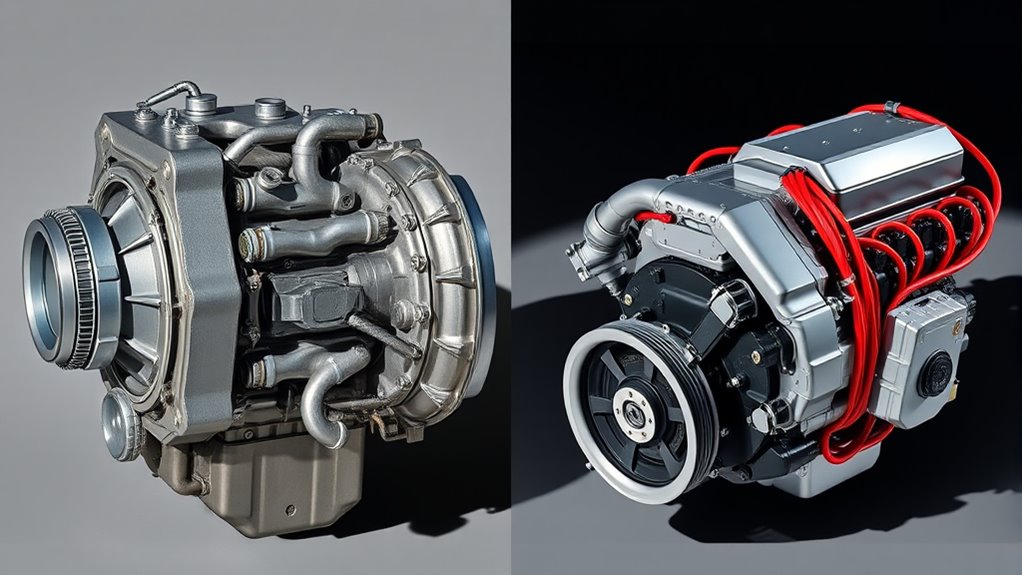
CI Engine vs. SI Engine: Differences in Efficiency, Torque, Costs, and Emissions
Are you overwhelmed trying to decide between a compression ignition (CI) engine and a spark ignition (SI) engine? Many people struggle with understanding which engine type best suits their needs, especially with all the technical details out there. Don’t worry—you’re not alone in feeling a bit confused.
You’ll find that CI engines are generally more efficient and produce more torque at low speeds due to their high compression ratios, making them ideal for heavy-duty tasks.
They tend to cost more upfront and require more maintenance but last longer.
SI engines are simpler, cheaper, and respond faster, perfect for lightweight applications.
Their emissions differ, with diesel producing more NOx and particulates, while gasoline emits more CO and VOCs. To learn more about these differences, keep exploring detailed comparisons.
Key Takeaways
- CI engines generally have higher thermal efficiency and fuel economy than SI engines because of their higher compression ratios.
- Diesel (CI) engines produce more torque at low RPMs, which makes them ideal for heavy-duty uses.
- SI engines usually cost less to build and maintain, thanks to their simpler design and lighter parts.
- Diesel engines tend to emit more NOx and particulate matter, while gasoline engines release higher levels of CO and VOCs, affecting environmental concerns.
- Looking ahead, many trends focus on hybrid systems, alternative fuels, and new technologies to reduce emissions for both engine types.
What Are the Main Differences Between CI and SI Engines?
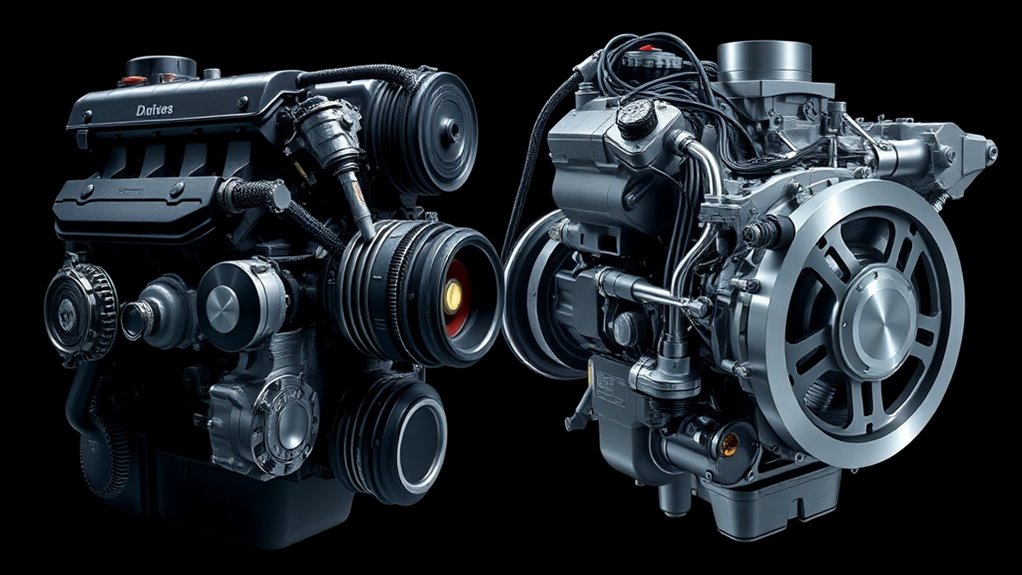
To understand the main differences between Compression Ignition (CI) and Spark Ignition (SI) engines, it’s helpful to see how they work. CI engines ignite fuel through compression, squeezing air and diesel until it heats enough to ignite the fuel injected afterward. SI engines, on the other hand, use a spark plug to ignite a fuel-air mixture. This key difference affects their design and maintenance needs.
Fuel additives mainly help in SI engines by improving fuel combustion and reducing deposits that can affect spark plugs and engine cooling. In contrast, CI engines usually need more robust cooling systems because their high compression ratios generate a lot of heat. Proper cooling is critical in both types, but CI engines really depend on it to prevent overheating and keep performance steady.
How Do Compression and Spark Ignition Influence Engine Efficiency?
The way engines ignite fuel really affects how efficiently they run, impacting how well they turn energy into work. In compression ignition (CI) engines, a high compression ratio squashes air until it gets hot enough to ignite fuel on its own, boosting efficiency.
Spark ignition (SI) engines rely on spark timing to control when the fuel ignites, which influences power output and fuel use. The way each engine handles ignition makes a big difference in overall performance.
Here are some key ways compression and spark ignition affect efficiency:
Compression and spark ignition methods are crucial for optimizing engine efficiency and fuel combustion.
- Compression ratio: Higher ratios improve thermal efficiency but can increase the chance of knocking in SI engines.
- Spark timing: Moving the spark earlier or later helps optimize combustion, reducing wasted fuel.
- Ignition control: Precise timing of sparks allows for better fuel burn, which boosts efficiency.
- Engine design: Fine-tuning the compression ratio and spark timing for each engine type maximizes energy conversion.
Which Engine Type Produces More Torque?
When comparing torque production, diesel engines, or compression ignition (CI) engines, generally generate more torque than spark ignition (SI) engines of similar size. This is because CI engines operate at higher compression ratios, which produces more force during combustion.
Turbocharging benefits are significant here, as they amplify torque output by forcing more air into the cylinders, enhancing power. Moreover, CI engines often use advanced cooling systems to manage heat generated by high compression, helping maintain optimal performance.
| Engine Type | Typical Torque Characteristics | Key Advantage |
|---|---|---|
| CI (Diesel) | Higher torque at lower RPM | Better towing and load capacity |
| SI (Gasoline) | Lower torque, higher RPM | Smoother acceleration |
| Both | Can be optimized with turbocharging | Increased torque potential |
How Do Manufacturing and Maintenance Costs Compare?
Manufacturing and maintenance costs for CI (diesel) engines are generally higher than those for SI (gasoline) engines. Diesel engines require more complex components and manufacturing processes, which increase costs. Maintenance expenses tend to be higher because of the need for robust parts designed for durability, like strengthened pistons and fuel systems.
Diesel engines cost more to produce and maintain due to their complex components and durable parts.
Key factors include:
- Production complexity: Diesel engines feature intricate fuel injection systems, raising manufacturing costs.
- Material costs: Heavier, more durable materials are necessary, increasing part expenses.
- Longer service intervals: Although maintenance might be less frequent, each session can be costly due to specialized components.
- Repair expenses: Repairs tend to be more expensive because of the engine’s tough construction and complex systems.
What Are the Emissions and Environmental Impacts of CI and SI Engines?
While both CI (diesel) and SI (gasoline) engines contribute to vehicle emissions, they do so in different ways that have a big impact on the environment. Diesel engines usually produce more nitrogen oxides (NOx) and particulate matter, which can lead to air pollution and health issues.
Gasoline engines tend to generate higher levels of carbon monoxide (CO) and volatile organic compounds (VOCs), which also hurt air quality. Automakers are exploring eco-friendly options like electric vehicles and hybrids to lessen environmental impact.
Strategies like advanced catalytic converters and diesel particulate filters help reduce harmful emissions from both types of engines. Diesel engines are typically more fuel-efficient, but their emissions can cause bigger air quality problems.
Knowing these differences can help you choose an engine that matches your environmental values and your community’s needs. Using effective control measures and cleaner technologies is key to building a more sustainable future.
Which Engine Offers Better Power and Performance?
Choosing between CI (diesel) and SI (gasoline) engines really depends on what kind of power and performance you’re after. Diesel engines usually give you more torque, which makes them great for towing and heavy loads. Gasoline engines tend to respond quickly and offer smoother acceleration, making everyday driving more enjoyable.
Diesel engines excel in torque and towing, while gasoline engines provide quick response and smooth acceleration.
To compare their performance, think about this: diesel engines produce more low-end torque because of higher compression ratios, which helps with pulling power. On the other hand, SI engines tend to cool down faster, supporting high-revving performance.
Lubrication systems in direct injection diesel engines handle higher pressures, which helps keep the engine durable even under tough conditions. Gasoline engines usually have lighter cooling systems, so they can adjust temperatures quickly and perform better at higher speeds.
In the end, your choice depends on the kind of power you need and how well the engine’s cooling and lubrication systems can support that power over time.
How Do Fuel Economy and Efficiency Differ Between Engine Types?
You’ll often find that compression ignition engines tend to have higher combustion efficiency, which usually means they get better fuel economy than spark ignition engines. But keep in mind, fuel consumption isn’t just about the engine type; it can change pretty a lot depending on the load and how the engine is operating.
Also, the way each engine delivers power makes a difference in how efficiently they turn fuel into useful work. So, even if one engine type is generally more fuel-efficient, real-world factors can influence how well it performs in different situations.
Combustion Efficiency Differences
How do fuel economy and efficiency differ between CI (compression ignition) and SI (spark ignition) engines? CI engines usually have higher combustion efficiency because they can better control the fuel mixture and when combustion happens. This precision helps burn more fuel completely, which means less waste.
In contrast, SI engines depend on spark timing that can vary, leading to less complete combustion. They rely on the spark plug to ignite the fuel-air mixture, which isn’t always perfectly timed.
Here’s a quick rundown:
- CI engines optimize the fuel mixture for maximum efficiency.
- They control combustion timing precisely for complete burning.
- SI engines’ spark timing can cause incomplete combustion.
- Overall, CI engines convert more fuel energy into useful work, making them more efficient.
These differences make CI engines generally more efficient, especially during steady and ideal operating conditions.
Fuel Consumption Variations
Because of their higher combustion efficiency, compression ignition (CI) engines generally use less fuel to produce the same power compared to spark ignition (SI) engines.
The fuel type also makes a difference; diesel, used in CI engines, has more energy per volume than gasoline, which powers SI engines.
The ignition system affects fuel consumption too. CI engines rely on compression to ignite fuel, removing the need for spark plugs and allowing more complete combustion.
This precise ignition process cuts down on fuel waste and boosts efficiency.
On the other hand, SI engines use a spark to ignite fuel, which can lead to slightly higher fuel use because combustion is less complete.
Power Delivery Dynamics
When it comes to power delivery, CI and SI engines differ a lot in how they turn fuel into usable energy. Diesel engines usually produce more torque at low RPMs, so their power delivery is more gradual and steady. Gasoline engines tend to respond quicker to throttle changes but often have less torque.
Turbocharging boosts power and efficiency in both engine types but is especially beneficial for diesels with high compression ratios. Good power delivery affects fuel economy because diesel engines use less fuel thanks to higher thermal efficiency.
Turbochargers help improve fuel use by increasing airflow without needing extra fuel. Catalytic converters cut emissions but can create slight backpressure, which may affect power.
Finally, precise power delivery makes SI engines more responsive. However, this can also mean higher fuel consumption during peak power demands.
What Are the Maintenance Expectations and Durability of CI and SI Engines?
Diesel (CI) engines generally need more careful maintenance than gasoline (SI) engines because they’re built to handle higher pressures and tougher conditions. You’ll want to pay special attention to their lubrication to prevent wear since they operate under intense heat and pressure.
The cooling system’s durability is also crucial because CI engines produce more heat. Regular checks are essential to keep everything running smoothly. Components like injectors and turbochargers tend to handle harsher conditions but still need periodic inspections.
On the other hand, SI engines usually have lower maintenance requirements thanks to their smoother operation and less stress on parts. They tend to be easier to care for overall.
| Aspect | Diesel (CI) Engine | Gasoline (SI) Engine |
|---|---|---|
| Lubrication | More frequent oil changes, high-quality oil needed | Less frequent, standard oil sufficient |
| Cooling System | Higher durability, regular checkups essential | Lower stress, easier maintenance |
| Component Wear | Accelerated wear on injectors and turbo | Less stress, longer intervals |
| Durability | Longer lifespan with proper care | Usually shorter lifespan |
Which Engine Is Best for Specific Applications?
When you’re trying to decide between CI (compression ignition) and SI (spark ignition) engines, it’s all about what you need the engine to do. For example, heavy vehicles tend to run better on diesel engines because they provide more power and better fuel efficiency for large loads.
On the other hand, small engines, like those in lawnmowers or portable generators, usually use gasoline because it’s simpler and keeps the overall design lightweight. Knowing these differences can really help you choose the right engine for your specific needs.
Suitability for Heavy Vehicles
Which engine type suits heavy vehicles best depends on their specific operational needs and performance goals. Diesel engines stand out because of their high torque, durability, and fuel efficiency.
They handle long hauls and heavy loads really well, making them ideal for freight transport and construction.
Consider these factors:
- Hybrid compatibility could help save fuel and cut emissions in heavy-duty work.
- Electric integration is improving, making electric or hybrid options more viable for short trips or specialized hauling.
- Toughness and reliability are crucial, so CI engines are preferred for tough environments.
- Cost and maintenance lean toward diesel for high-mileage use, while electric or hybrid systems are better for future fleet upgrades.
In the end, the best choice depends on balancing operational needs, costs, and environmental targets.
Ideal for Small Engines
Choosing the right engine for small applications depends on the specific tasks and constraints.
Spark Ignition (SI) engines are often best because they’re simple and easy to maintain. They respond well to fuel additives that boost performance and efficiency, especially when fuel quality varies.
Proper lubrication techniques are key to reducing wear and ensuring smooth operation in small engines. SI engines are lightweight and compact, making them perfect for generators, lawnmowers, and small vehicles.
While Compression Ignition (CI) engines provide more power and efficiency, they tend to be larger and more complex. That makes them less practical for small-scale use.
For most small-engine jobs, SI engines with the right fuel additives and lubrication are the way to go.
What Are the Emerging Trends and Future Innovations in CI and SI Engines?
Emerging trends in both compression ignition (CI) and spark ignition (SI) engines are driven by advances in fuel technology, electronics, and materials science. These innovations aim to boost efficiency, cut emissions, and prepare for the shift to electric power.
Advances in fuel tech, electronics, and materials are shaping efficient, low-emission engines for a cleaner, electric-ready future.
You’ll see a strong push toward hybrid systems, combining traditional engines with electric motors to improve performance and fuel economy. Efforts to develop alternative fuels like biofuels and low-carbon options are also gaining ground.
Key innovations include enhanced engine control units (ECUs) for better precision and adaptability. Lightweight, durable materials are being used to improve efficiency and extend engine lifespan.
Start-stop systems and regenerative braking are also in focus, helping save fuel and reduce emissions. Hybrid and plug-in hybrid systems are making it easier to switch to electric, paving the way for a smoother transition in transportation.
Frequently Asked Questions
How Do CI and SI Engines Compare in Terms of Noise Levels?
You’ll notice that CI (Compression Ignition) engines generally produce more engine noise and higher sound levels compared to SI (Spark Ignition) engines. The sound levels in CI engines are usually louder because of their rougher combustion process, which leads to increased noise during operation.
On the other hand, SI engines tend to run more quietly. That’s why they’re often preferred for applications where lowering noise levels is important.
What Safety Considerations Are Unique to Each Engine Type?
You should be aware that CI engines pose safety risks related to high compression ratios, which can cause engine knocking or even fires if not properly maintained.
SI engines are safer regarding engine maintenance because they operate at lower pressures, reducing potential hazards.
Furthermore, ensuring fuel compatibility is vital; using incorrect fuel in a CI engine might lead to damage, while SI engines are more forgiving but still require proper maintenance for safety.
Are There Differences in Cold-Weather Starting Capabilities?
In cold weather, starting your engine can be more difficult, especially for CI engines since they rely on high compression for ignition. When temperatures drop, achieving that compression can be tougher, making it harder to start.
On the other hand, SI engines tend to start more easily because they use spark plugs for ignition, which makes cold starts smoother. They’re generally more forgiving in chilly conditions.
To improve cold-weather starts, you might want to use block heaters or starting fluid. This is especially helpful for CI engines to prevent ignition difficulties when it’s really cold outside.
How Do CI and SI Engines Handle Alternative Fuels?
Imagine trying to fit a square peg into a round hole—that’s how straight swaps of alternative fuels can seem for CI and SI engines.
CI engines handle biodiesel and some alternatives better, often with minimal modification. But for SI engines using ethanol or compressed gases, more challenging engine modifications may be needed.
You realize that adapting engines for alternative fuels often involves overcoming these modification challenges. Each engine type offers different levels of flexibility and efficiency in the process.
What Are the Typical Lifecycle and Depreciation Rates for Each Engine?
You should know that diesel engines (CI) generally have longer lifespans because of their durability, so their depreciation rates tend to be slower.
Gasoline engines (SI), on the other hand, tend to depreciate faster due to higher maintenance costs and more wear over time.
Both types need regular maintenance, but CI engines often save you money in the long run because they last longer.
Conclusion
Ultimately, choosing between a CI and SI engine depends on your needs, but remember, your decision could be as impactful as steering the world’s future!
If you crave raw power and durability, CI engines are a heavyweight champ. They excel in torque and are often more rugged for tough jobs.
For cleaner, more efficient rides, SI engines shine brightest. They tend to be simpler and cost less upfront, making them great for everyday driving.
Keep up with innovations because they’re transforming engines faster than you can say “fuel efficiency,” turning your driving experience into something truly extraordinary.
The future of engines, especially in terms of efficiency, torque, costs, and emissions, is waiting. Are you ready to lead the charge?