How to Charge a Car Battery Without a Battery Charger Easily
Struggling to start your car when the battery’s dead? You’re not alone—many people find themselves stuck with a powerless car, especially when they don’t have a traditional charger on hand.
Luckily, there are simple ways to get your engine running without specialized equipment.
You can charge a car battery without a traditional charger by jump-starting it with another vehicle using jumper cables. Just ensure proper connection from positive to positive and negative to a grounding point.
You can also use household items like lemon juice or vinegar for temporary conductivity, or employ portable power banks designed for emergency boosts.
However, always prioritize safety and correct procedures.
If you want to find out more effective and safe methods, keep exploring this guide.
Key Takeaways
- Use jumper cables to connect the dead battery to a charged vehicle’s battery. Make sure to follow correct polarity and safety procedures.
- Before starting, ensure both vehicles are off. Connect the positive clamps first, then the negative clamps, and only then start the booster vehicle.
- Let the working vehicle run for a few minutes to transfer some charge. Then try to start the dead car.
- Once the dead car starts, disconnect the cables in reverse order. Be careful to avoid contact between clamps or with metal surfaces.
- Regularly check and clean your battery terminals. This helps keep connections good and makes jump-starting easier when needed.
How Can I Jump-Start My Car Without a Charger?
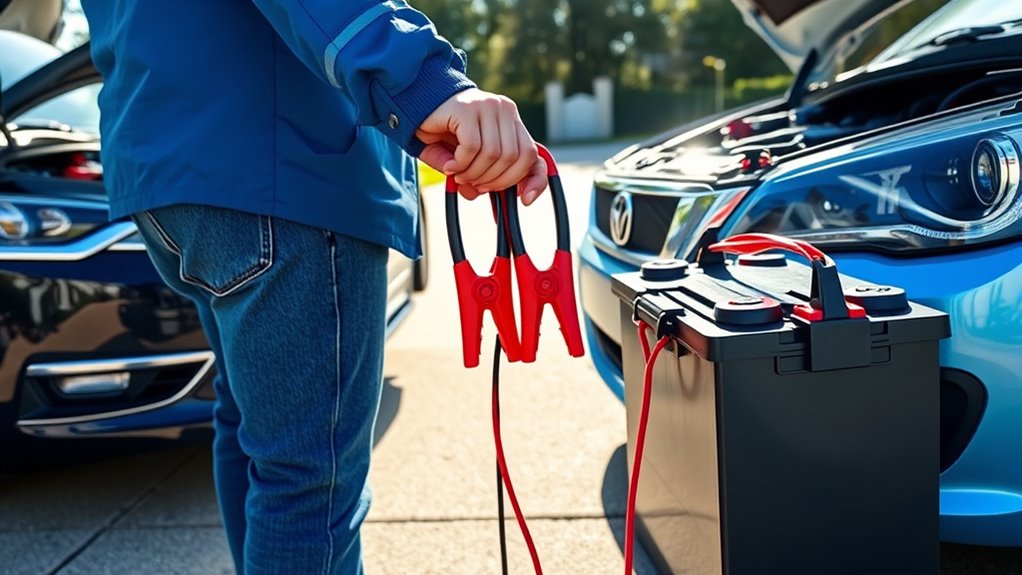
If your car battery is dead and you don’t have a battery charger handy, jump-starting it can be a quick fix. To do this safely, understanding battery chemistry helps you see how charging cycles affect your battery’s lifespan.
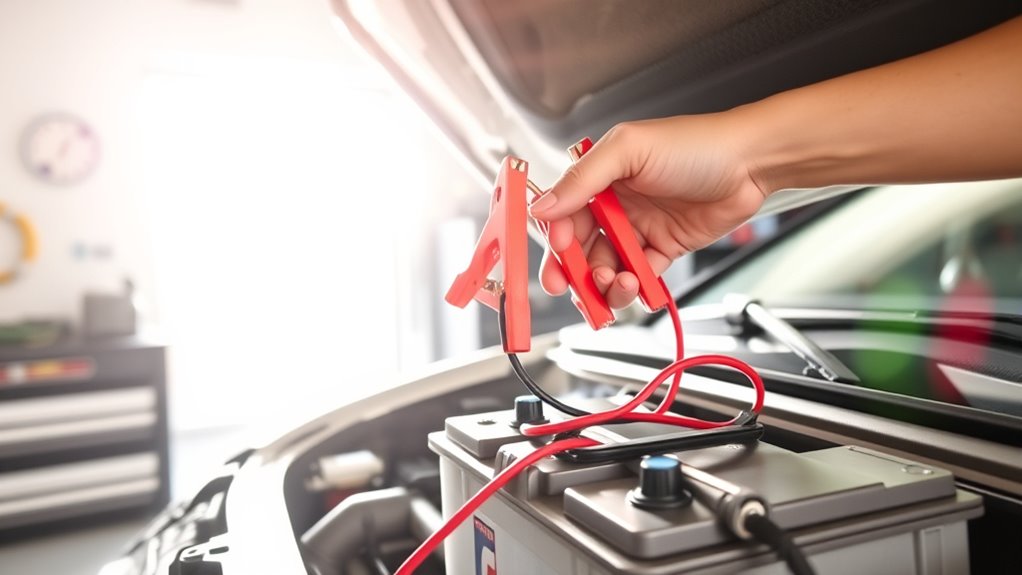
Connect the jumper cables correctly: positive to positive, negative to negative. Attach the positive cable to your dead battery, then to the booster vehicle’s positive terminal. Do the same with the negative cable, attaching it to the booster vehicle’s negative terminal and a secure grounding point on your car’s engine block.
Start the booster vehicle and let it run for a few minutes to transfer charge. Remember, repeated jump-starts can impact the chemistry inside your battery and influence charging cycles, potentially reducing its overall lifespan.
Always follow safety procedures and make sure the cables are well-connected to prevent sparks or damage.
What Household Items Can Help Charge a Dead Car Battery?
While household items can’t fully recharge a dead car battery like specialized chargers, some tools can give you a temporary boost or help you out in an emergency. These items won’t replace proper repairs but can help you get going until you can get professional help. Be cautious, as handling battery acids can be hazardous, so protective gear is essential.
You can try to revive your battery with:
- Baking soda and water: Mix them to neutralize minor battery acid leaks, but don’t rely on this for a full charge.
- Lemon juice or vinegar: These mild acids might temporarily increase battery conductivity.
- A working vehicle: If accessible, you can use its alternator for a makeshift jump-start.
- A multimeter: Use it to check your battery’s voltage and see if corrosion or damaged cells might need professional attention.
How to Safely Use a Working Vehicle to Jump-Start Your Car
Before you jump-start a car, double-check that both vehicles are in park or neutral, and make sure the parking brakes are on. It’s always good to have everything turned off before connecting the cables.
Next, connect the jumper cables — start with the positive terminals, then attach the negative terminal. Remember to follow all safety steps to avoid sparks or other hazards. Once your dead battery is charged and the car is running smoothly, remove the cables in the reverse order. Be careful not to let the clamps touch each other or any other metal surfaces during the process.
Prepare Both Vehicles Securely
Ensuring both vehicles are secure is the first step before jump-starting. You want to prevent any movement that could cause damage or accidents. Make sure both cars are parked on level ground, in park or neutral, with parking brakes engaged. Turn off the ignition and remove the keys to avoid fire hazards. Check your insurance policies, as some coverage might have specific procedures for jump-starting without a professional. Confirm that both cars are in good condition—regular maintenance helps prevent unexpected issues.
Park the vehicles close but not touching. Engage the parking brakes on both cars. Turn off all electrical components and remove the keys to secure the vehicles.
Connect Jumper Cables Correctly
| Step | Connect | Location |
|---|---|---|
| 1 | Red | Dead battery positive terminal |
| 2 | Red | Live vehicle positive terminal |
| 3 | Black | Live vehicle negative terminal |
| 4 | Black | Metal engine surface on dead vehicle |
Start and Remove Safely
Once your jumper cables are securely connected, start the working vehicle and let it run for a few minutes. This helps transfer charge to the dead battery safely and effectively.
When enough charge has been transferred, you can begin preparing to disconnect. Remember, staying safe with the batteries is really important during this process.
After the dead battery shows signs of life, carefully remove the cables in the reverse order of connection, making sure the clamps don’t touch.
Start by disconnecting the black (negative) cable from the dead vehicle. Then, take it off from the working vehicle.
Next, remove the red (positive) cable from the working vehicle, followed by the red cable from the dead battery.
Make sure both vehicles are off during removal, and check your vehicle’s manual for any specific instructions. This way, you’re helping ensure a safe and effective jump-start.
Can Portable Power Banks Charge Your Car Battery? How?
While portable power banks are great for charging smartphones and small devices, they usually can’t jump-start or fully charge a car battery. Most of these power banks only provide enough power for low-voltage gadgets, not the high current needed for a car battery.
Trying to use a regular power bank to charge your car battery just won’t work because it can’t deliver the power needed. Some high-capacity power banks made as jump starters can temporarily boost a dead battery, but regular portable power banks lack the right features.
They simply aren’t designed for this purpose. If you want to charge your car battery, it’s best to use equipment made specifically for that task. Relying on a standard power bank for this isn’t realistic or safe. Don’t count on it to fix a dead car battery.
How to Manually Boost Your Car Battery With Jumper Cables Safely
If your car’s battery dies unexpectedly, you can safely boost it using jumper cables and another vehicle with a working battery. First, make sure both cars are turned off.
Attach one red clamp to the dead battery’s positive terminal, then connect the other red clamp to the good battery’s positive terminal. Next, connect one black clamp to the good battery’s negative terminal, and attach the remaining black clamp to a solid metal surface away from the dead battery.
Attach red clamps to positive terminals, black clamps to negative terminals and a metal surface away from the dead battery.
Start the working vehicle and let it run for a few minutes to transfer charge. Then, try starting your car. While doing so, it’s a good idea to test the battery to see if it needs replacing or if other charging options like jump-starting are better.
Always follow safety precautions to avoid sparks or damage. Remember, jumper cables aren’t a permanent fix, but they can give you time to figure out other ways to restore power.
Can Solar Chargers Help Recharge a Dead Car Battery?
Can solar chargers effectively recharge a dead car battery? The answer depends on the battery’s condition and the charger’s power. Solar chargers use renewable energy from the sun to generate electricity, making them an eco-friendly option for maintaining or slowly recharging batteries.
However, most small solar chargers are better suited for trickle charging or maintaining a healthy battery, rather than jumpstarting a completely dead one. If you’re considering solar power, *guarantee* you select a model with enough wattage to deliver a meaningful charge.
With battery recycling and sustainability in mind, solar chargers offer a green alternative to traditional recharging methods, reducing reliance on fossil fuels. Keep in mind, they often require sunlight for *best* performance, so their effectiveness varies with weather and shading conditions.
Ultimately, while solar chargers can support battery maintenance and boost slightly discharged batteries, they might not be enough for fully dead ones without extra help.
What Are Quick DIY Methods to Revive a Low or Dead Car Battery?
When your car battery is low or dead, quick DIY methods can help you get back on the road without needing a professional jumpstart. These approaches are useful for immediate battery maintenance and can give you temporary power, especially when conventional chargers aren’t around.
Quick DIY fixes can temporarily revive your car battery when conventional chargers aren’t available.
You can try some simple tricks to revive your battery:
- Use a compatible portable power bank designed for car batteries to give it a quick boost.
- Jump-start with another vehicle by connecting jumper cables, which provides an alternative power source.
- Clean corrosion off battery terminals with a wire brush to improve contact and performance.
- Tap or gently shake the battery case to help loosen internal plates, but only if you suspect minor internal issues.
Always prioritize safety, and remember these methods are for temporary fixes. If your battery keeps failing, think about proper maintenance or replacing it to avoid future dead cells.
When Should You Avoid DIY Charging and Seek Professional Help?
Knowing when to seek professional help instead of attempting DIY charging methods is essential for your safety and your vehicle’s health.
If you notice signs of severe battery damage, like corrosion, leaks, or a swollen case, avoid trying to fix it yourself and instead consult a professional.
Attempting to charge a damaged battery can be dangerous and may cause fires or chemical leaks.
If your car still won’t start despite your efforts, or if you’re unsure about the battery’s condition, it’s best to get expert help.
Professionals have specialized equipment to diagnose and perform safe repairs, ensuring your vehicle stays in good shape.
Don’t risk damaging the battery further or risking your safety by ignoring warning signs.
When in doubt, it’s smarter to have a pro handle complex issues or hidden damage that DIY techniques can’t fix properly.
This approach keeps both you and your vehicle safe.
Tips to Maintain Your Car Battery and Prevent Future Dead Batteries
Regularly checking your battery is a great way to catch any problems early on, so you aren’t left stranded out of nowhere. It’s also a good idea to keep the terminals clean — that way, you ensure a solid connection and prevent corrosion, which can drain your battery over time. Staying on top of these little things really helps reduce the risk of your battery dying unexpectedly and keeps your car running smoothly day in and day out.
Regular Battery Inspection
Performing regular battery inspections is essential to keep your car reliable and avoid unexpected dead batteries. Check for signs of corrosion around the terminals, as buildup can block power flow.
Make sure your charging cables are in good shape and securely connected, especially if you’re jump-starting the vehicle. Look for loose or damaged cables that could cause charging problems or prevent the battery from working properly.
Also, inspect the battery’s surface for cracks or leaks, which mean it might be time for a replacement. Regularly testing the battery’s voltage with a multimeter can help catch issues early.
Keep Terminals Clean
Keeping your battery terminals clean is essential to prevent corrosion, which can block electrical flow and cause your battery to die earlier than it should.
Corrosion looks like a white or bluish powder around the terminals and can mess up the connection. Regular cleaning helps keep your battery working properly.
To clean the terminals, disconnect the negative terminal first, then the positive. Use a mixture of baking soda and water or a commercial terminal cleaner.
Scrub away the corrosion with a wire brush or toothbrush, making sure to get rid of all the buildup. Once clean, rinse with water and dry thoroughly before reconnecting.
Proper terminal cleaning reduces the chance of dead batteries, extends your battery’s lifespan, and keeps your vehicle starting reliably.
Troubleshooting Common Problems When Charging Your Car Battery at Home
Sometimes, despite your best efforts, charging a car battery at home can run into issues. One common problem is battery corrosion on terminals, which can prevent proper charging. If you see a white or bluish substance, clean the terminals with a wire brush or a mix of baking soda and water.
Faulty or cheap charging accessories can also cause problems. Always use reliable, suitable tools to ensure everything works correctly.
To troubleshoot effectively:
- Check for battery corrosion and clean the terminals if needed.
- Make sure your charging accessories are compatible and in good shape.
- Verify all connections are secure and free of dirt or corrosion.
- Confirm the battery isn’t beyond recovery or internally damaged.
Fixing these issues helps make the charging process smoother and prevents damage to your battery or tools. Proper maintenance and attention to detail make home charging safer and more successful.
Frequently Asked Questions
Can You Charge a Car Battery Inside the Vehicle?
Yes, you can charge a car battery inside the vehicle, but be careful. Make sure the battery is well-insulated with proper battery insulation to prevent sparks.
Use a multimeter or voltage indicators to monitor the voltage levels during charging. Connect a safe external power source, like another vehicle or a makeshift setup.
Keep an eye on the voltage indicators to avoid overcharging or damaging the battery. Always proceed with caution when charging a battery inside a vehicle.
How Long Does It Take to Charge a Dead Car Battery at Home?
Waiting for your dead battery to come back to life? It usually takes about 4 to 24 hours to fully charge a car battery at home, depending on its voltage and how drained it is.
If you’re using a DIY charging method, be patient and keep a close eye on the charging time. Watch the voltage levels and aim for around 12.6 volts for a healthy, charged battery.
What Are the Dangers of Using DIY Methods to Charge a Battery?
Using DIY methods to charge a battery poses safety hazards and increases your risk of accidents. You might encounter electric shocks, fires, or explosions if you mishandle the process.
Inexperienced attempts can also damage the battery or your vehicle’s electrical system. Always remember, DIY risks are significant, so it’s safer to use proper equipment or consult a professional.
Never compromise safety by rushing or improvising unnecessary steps.
Is It Safe to Use Household Electronics to Charge a Car Battery?
Using household electronics to charge a car battery isn’t safe and isn’t recommended for battery maintenance. These devices aren’t designed for that purpose and can pose serious safety risks like electrical shocks or fires.
Always follow safety precautions, such as wearing gloves and eye protection, and use proper equipment like a dedicated battery charger.
Prioritize safety to prevent damage to your vehicle and avoid injury during any DIY charging attempts.
How Can You Tell if a Car Battery Is Repairable or Needs Replacement?
You can tell if your car battery is repairable or needs replacing by checking its lifespan. Most batteries last about 3 to 5 years.
Look for repair indicators like corrosion, leaks, or a swollen case. These are signs you should consider replacing it.
Perform a voltage test; if it’s below 12.4 volts, the battery might be damaged beyond repair.
If issues persist after cleaning and testing, replacing the battery is usually the safest choice to ensure reliable vehicle performance.
Conclusion
Remember, an ounce of prevention is worth a pound of cure. Regularly check your battery’s health, keep terminals clean, and avoid leaving your lights or accessories on.
If you’re ever in doubt, don’t hesitate to seek professional help. Safe handling and timely maintenance save you time, money, and stress.
With a little effort and caution, you can keep your car running smoothly. Knowing how to charge a car battery without a charger can help you stay prepared for unexpected battery issues on the road.